


2026 Edition — Feldman at a Hundred: Three Voices and Kristia Michael
Sunday 29 November, 7.30 pm – Teatro del Lavoro
Musica in Prossimità dedicates the closing concert of its 12th edition to Morton Feldman, celebrating the influential American composer on the centenary of his birth.
Known for his long-duration pieces and his sparse musical language, free from any predictable development, Feldman’s works alter our perception of time. His music is full of repetitions, yet nothing ever repeats itself: even if individual chords, textures and rhythmic ideas recur, they are never the same; if anything, they exist within a process of constant variation. Feldman’s pieces neither hypnotise us nor immerse us in a comforting bath of sound; on the contrary, they demand our attention and, through it, transform us (Tom Service, The Guardian, 2012).
These qualities emerge with remarkable immediacy in Three Voices (1982), an unusually short piece by Feldman that, in just over 50 minutes, manages to distill many of the insights that made his music so extraordinary. Performed for Musica in Prossimità by Cypriot singer Kristia Michael, Three Voices was Feldman’s last work for solo voice. The composer drew inspiration from soprano Joan La Barbara, a leading figure in the exploration of the expressive possibilities of the human voice in contemporary music, to whom he dedicated the piece and who gave its world premiere alongside two loudspeakers carrying her pre-recorded voices.
The interplay of the three voices, evenly distributed throughout the space, gives rise to a sense of total transcendence: of the voice, which loses its primary quality as singing and becomes pure sound, but also of physical existence, through polyphony, which alters the audience’s sense of space and time. This is what makes the work so original, with its focus on the intimacy of the voice and the experience of listening: it is the voice that takes on a meditative quality, without moving towards a conclusion, while the audience is invited to listen attentively, sustaining its concentration.
Program
➺ Three Voices (1982) by Morton Feldman
for voice and fixed media
Kristia Michael
(voice)
Marco Marasciuolo
SMET Scuola di Musica Elettronica del Conservatorio di Torino, (sound direction)

2026 Edition — Feldman at a Hundred: Three Voices and Kristia Michael
Sunday 29 November, 7.30 pm – Teatro del Lavoro
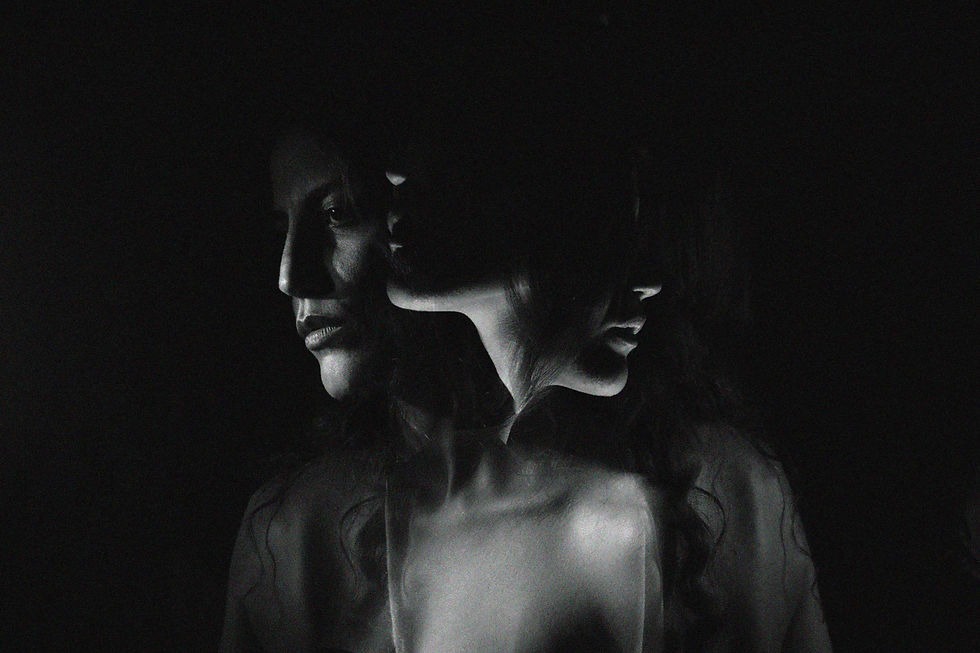
Kristia Michael
Kristia Michael is a cypriot vocalist, composer and sound artist based in the Netherlands. Her work centres on the experiential, ritualistic, and spiritual aspects of voice and sound, within contemporary and early music.
She devotes her practice to the creation of new works, collaborating with composers on premieres, contributing to recordings, and engaging in multidisciplinary and experimental projects. Her research includes the use of extended vocal techniques, pure tones, folk timbres and elements from performance art.
She has performed as a soloist at the Dutch National Opera and Ballet, AngelicA Festival, Greek National Opera, Dag in de Branding, November Music and collaborated with the Opera Forward Festival, Muze van Zuid and K3 Tanzplan Hamburg, among others. Her performance work spans ensembles and institutions including Nieuw Amsterdams Peil, MusicAeterna, Orkest de Ereprijs, Ensemble Modelo62, and the Cyprus Symphony Orchestra. She is the founder and artistic director of Sibil·la Ensemble, a medieval music group dedicated to the sacred and secular traditions of Western medieval music, and a member of Kali Ensemble.
As a composer, her pieces have been premiered at Dag in de Branding and SPRING Festival in the Netherlands, EPICENTROOM Festival and the State Hermitage Museum in Russia, IMZ International Music + Media Centre in Austria, and Kournos Music Festival in Greece.
2026 Edition — Feldman at a Hundred: Three Voices and Kristia Michael
Sunday 29 November, 7.30 pm – Teatro del Lavoro
Morton Feldman
Morton Feldman (1926-1987) was an American composer. Born in Manhattan to a Jewish family that had emigrated from Ukraine, he studied piano with Vera Maurina Press, followed by counterpoint with Wallingford Riegger and composition with Stefan Wolpe, through whom he met Edgard Varèse. In 1950, he met John Cage, with whom he shared an interest in musical forms that challenged established compositional conventions. Through Cage, he came into contact with artists and musicians who would form the so-called New York School, including Earle Brown, Christian Wolff and David Tudor.
From the early 1950s onwards, Feldman developed a compositional language centred on exploring new relationships between sound, duration and perception. He experimented with aleatoricism through graphic notation, in which certain parameters were left to the performer’s discretion. To prevent his work from being mistaken for a form of improvisation, he abandoned these techniques and turned instead to minute variations in timbre, dynamics and rhythm, developing structures characterised by irregular repetitions and imperfect symmetries, far removed from traditional principles of musical development and tension. From the 1970s onwards, this research led to compositions of increasingly extended duration, in which the stretching of time and the subtlety of variation challenge habitual modes of listening.
His work was profoundly influenced by his dialogue with the visual arts and his association with painters such as Mark Rothko, Philip Guston, Franz Kline, Jackson Pollock, Robert Rauschenberg and Cy Twombly, as well as by his relationship with the poet Frank O’Hara. In the 1970s, his interest in Middle Eastern carpets led him to develop the concept of ‘crippled symmetries’, applied to the metrical organisation of his compositions. In 1971-1972, he was artist-in-residence in Berlin at the invitation of the DAAD (Deutscher Akademischer Austauschdienst), the German Academic Exchange Service; on his return to the United States in 1973, he was named appointed at the State University of New York at Buffalo, where he taught until his death. In 1976, he met Samuel Beckett, with whom he established an artistic collaboration that culminated in the opera Neither (1977), based on a text by the Irish writer. He also dedicated Words and Music and For Samuel Beckett, both from 1987, to Beckett.
Among his best-known works are Projection 1 (1950), the first composition in which he experimented with graphic notation; The Rothko Chapel (1971); and String Quartet (II) (1983), which lasts almost five hours. Characterised by increasingly meticulous writing and a freedom from formal conventions and audience expectations, Feldman’s compositions have helped redefine the relationship between duration, perception and listening in contemporary music.
